Pest Information
Identify a Pest
Narrow down what you are seeing before you respond.
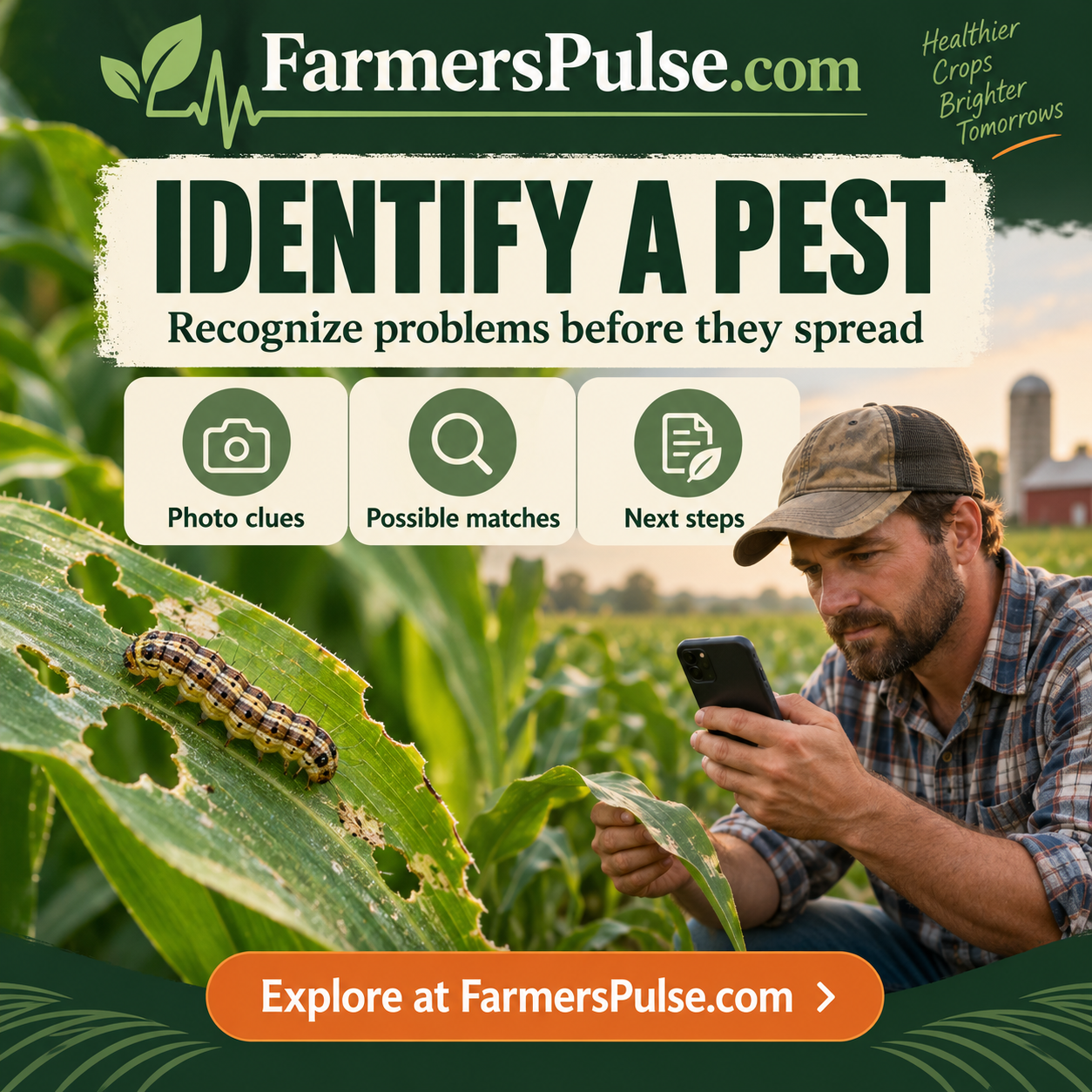
Use photos, crop details, symptoms, location and timing to compare likely insects and other crop pests.
A quick identification can be useful, but a wrong identification can waste money, delay treatment or harm beneficial organisms. Identify a Pest is designed to help you collect the right evidence and compare possible matches without pretending that a photograph alone provides certainty.
Take clear photographs of the whole plant, the damaged area and the insect or organism from more than one angle. Add the crop, plant part, field location, date and pattern of damage. FarmersPulse can return possible matches, distinguishing characteristics, life-cycle information and next verification steps.
Photograph and describe the evidence
- Use sharp images in natural light.
- Include a coin, ruler or familiar object for scale when helpful.
- Photograph the top and underside of leaves, stems, roots or fruit.
- Note whether damage appears on field edges, scattered plants or the whole field.
- Record recent weather, irrigation, fertilizer and pesticide activity.
What a responsible result should show
- Several possible matches when uncertainty exists
- Features that support or contradict each match
- Beneficial or harmless look-alikes
- Monitoring and nonchemical management options
- Links to locally appropriate extension or regulatory information
- A clear recommendation to seek expert confirmation when risk is high
Before using a pesticide
- Confirm the pest and determine whether action is necessary.
- Read and follow the complete product label.
- Check crop, pest, application rate, timing and re-entry restrictions.
- Protect pollinators, beneficial insects, water and neighboring properties.
- Record what was applied, where, when and why.
Put this guide into practice
Open the FarmersPulse tool and apply the guidance to your own farm.